Open the public feedback board of almost any feedback tool and search for “notion”. On Canny’s own board it is the top-voted item in the Integrations category, opened in 2019. On Featurebase it has carried a Planned status for three years. Nobody in the category has shipped it.
Most Field Notes entries study a feature a competitor built. This one studies a feature none of them built. That turned out to be more interesting. We spent the evening reading four vendors’ public catalogs and request threads, and then we built the integration the threads describe.
Four catalogs, zero Notion
One honesty note before the numbers. Our admin sessions on all four tools had expired the night we did this, and we did not log back in, so every claim here comes from public surfaces: marketing integration catalogs, public feedback boards, help centers. For an absence claim, the public catalog is the right evidence anyway. It is each vendor’s own “here is everything we integrate with” list.
- Canny lists 27 integrations across four groups, six of them issue-tracker pushes (Jira, GitHub, ClickUp, Linear, Azure DevOps, Asana). No Notion. Five of the eight entries in the catch-all group are generic no-code bridges: Zapier, Make, Pabbly, Integrately, SureTriggers.
- Featurebase lists 12. No Notion. The page ends with a card that reads “Can’t find the integration you need? Open a request on our public feedback portal and we’ll add it sooner than you think.”
- Sleekplan leads with the headline “Twelve native integrations, plus 6,000+ more through Zapier.” A page-wide search for “notion” comes back empty. Their escape hatch is the most explicit of the four: a “Build your own” block offering a REST API, webhooks, a JavaScript SDK, and an MCP server.
- Frill has no public integrations catalog at all. Both catalog URLs 404, and the help center describes its Integrations section only as “Instructions for our ever-growing list of integrations” with no article titles on the index.
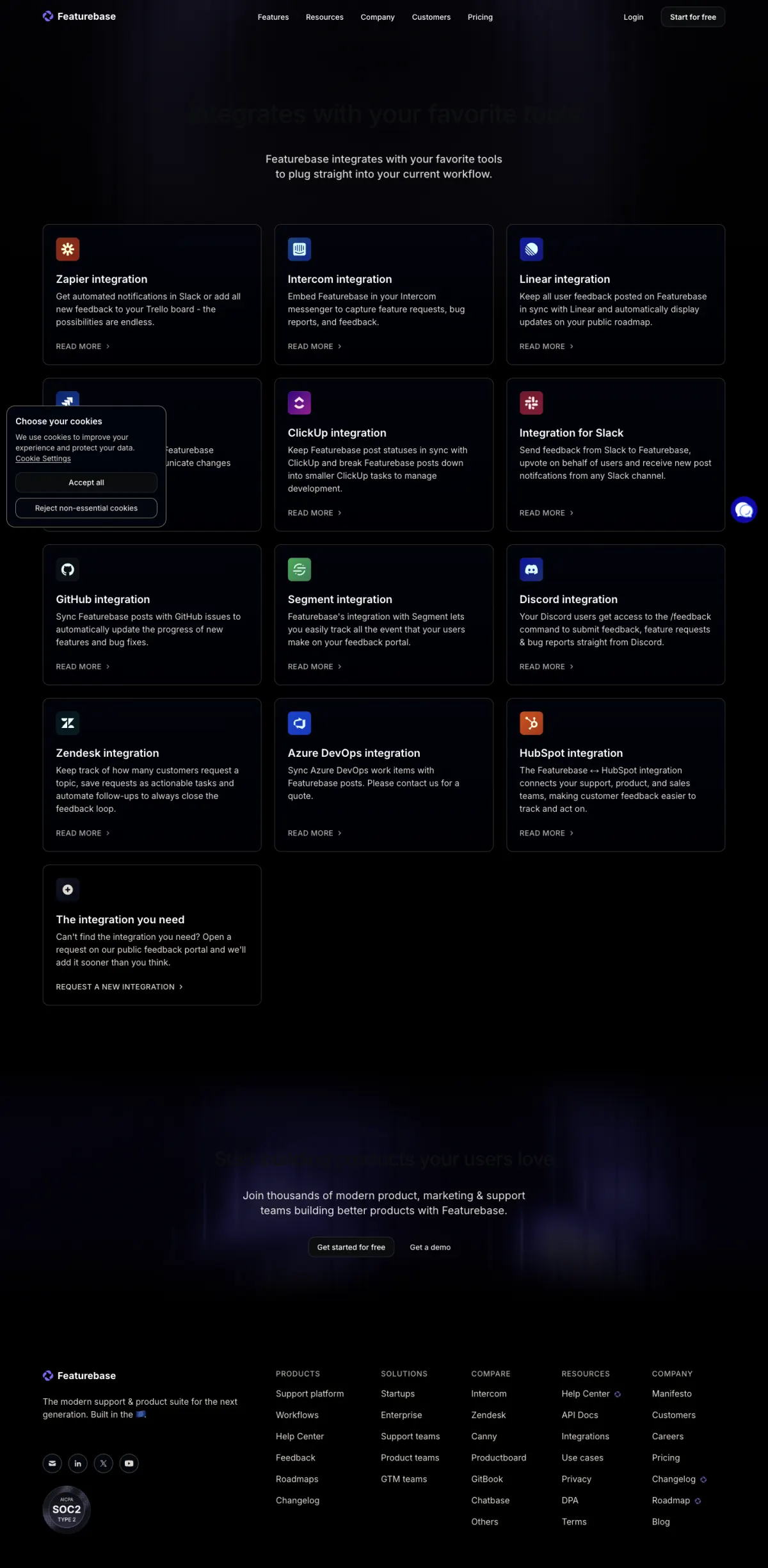
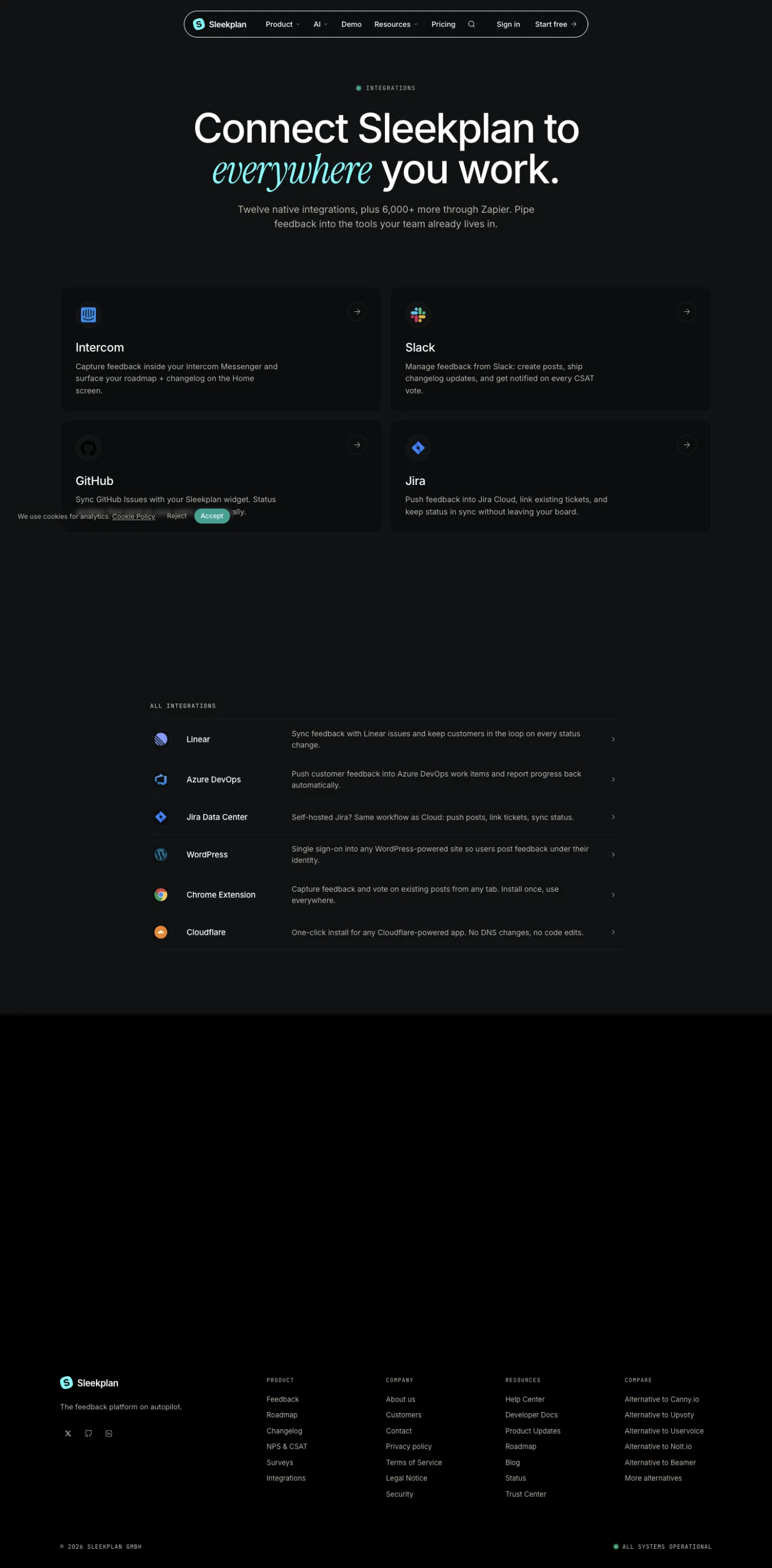
So the pattern is uniform. Every vendor routes Notion demand to a generic bridge, or to an API and the suggestion that you build it yourself. That rules out one company’s blind spot. All four looked at the same demand and made the same call.
Seven years of Under Review
The Canny request was opened on 5 August 2019. It has 249 votes and is the top-voted item on their Integrations board, which holds 198 posts. As of August 2026 the status is still Under Review.
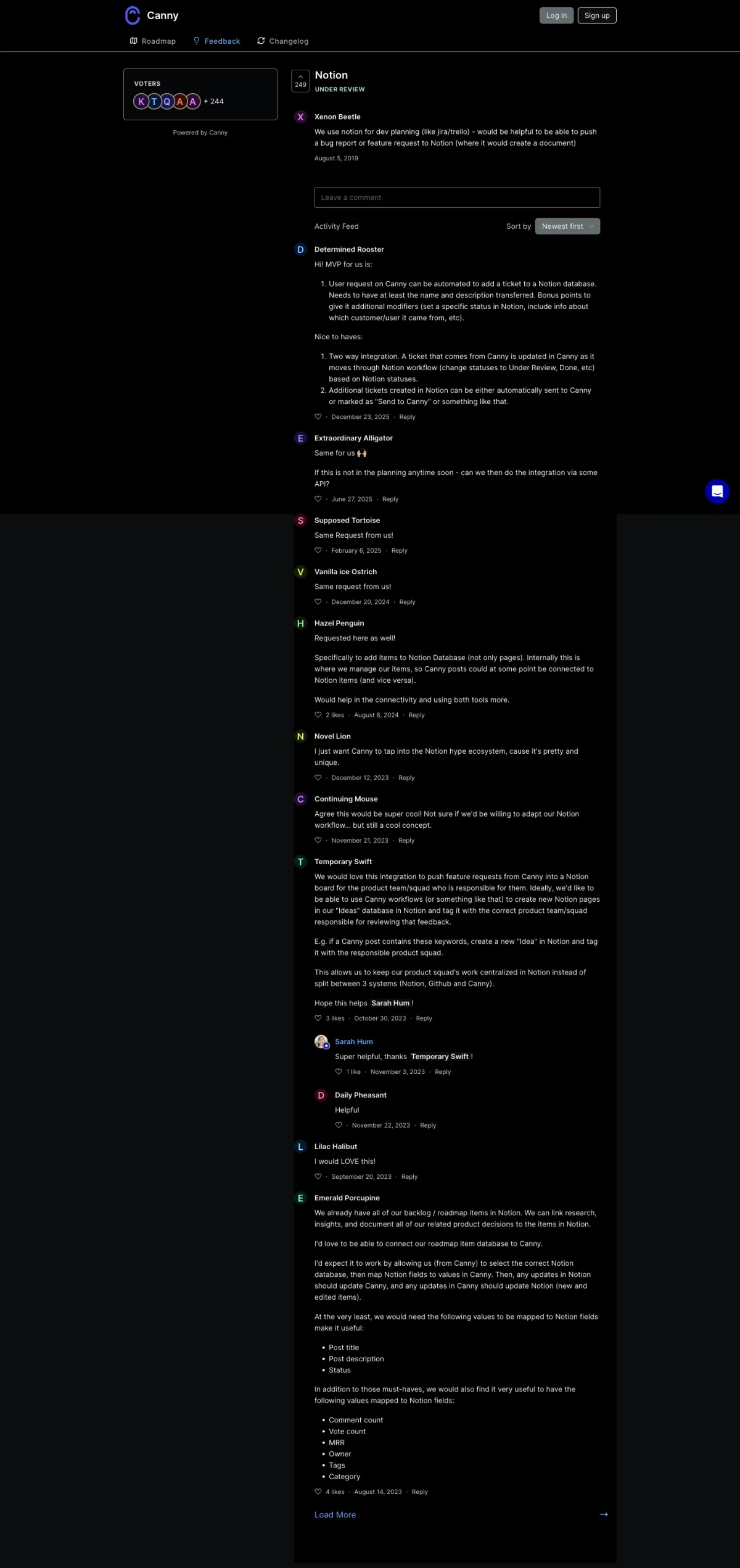
“We use notion for dev planning (like jira/trello) - would be helpful to be able to push a bug report or feature request to Notion (where it would create a document)”
“At the very least, we would need the following values to be mapped to Notion fields make it useful: Post title, Post description, Status.”
“MVP for us is: User request on Canny can be automated to add a ticket to a Notion database. Needs to have at least the name and description transferred.”
Across the whole thread there is exactly one reply from the Canny team, from a co-founder in November 2023: “Super helpful, thanks!” No commitment or ETA, and no status change since. And to be fair to them, a co-founder reading a seven-year-old integration thread and thanking a commenter by name is more attention than most backlogs get.
Three years of Planned
The Featurebase thread is the one that stayed with us, because the team engaged. The request has 196 votes, sits on Planned, and is about three years old. At least two other Notion posts were merged into it along the way, so 196 undercounts the distinct requesters. The status history, in order: the team marked it Planned three years ago (“we’ll definitely be adding the Notion integration soon”), told a follow-up asker it was on the roadmap a year later, then gave an ETA of “early Q2”. When an admin asked whether that ETA still held, the answer was “we still expect the ETA to be at the end of Q2 this year”.
After that, the thread goes one-directional. Five separate people have asked for a status update since, the most recent three months ago: “Is it realistic that this integration will be available this year?” None of the five got a reply.
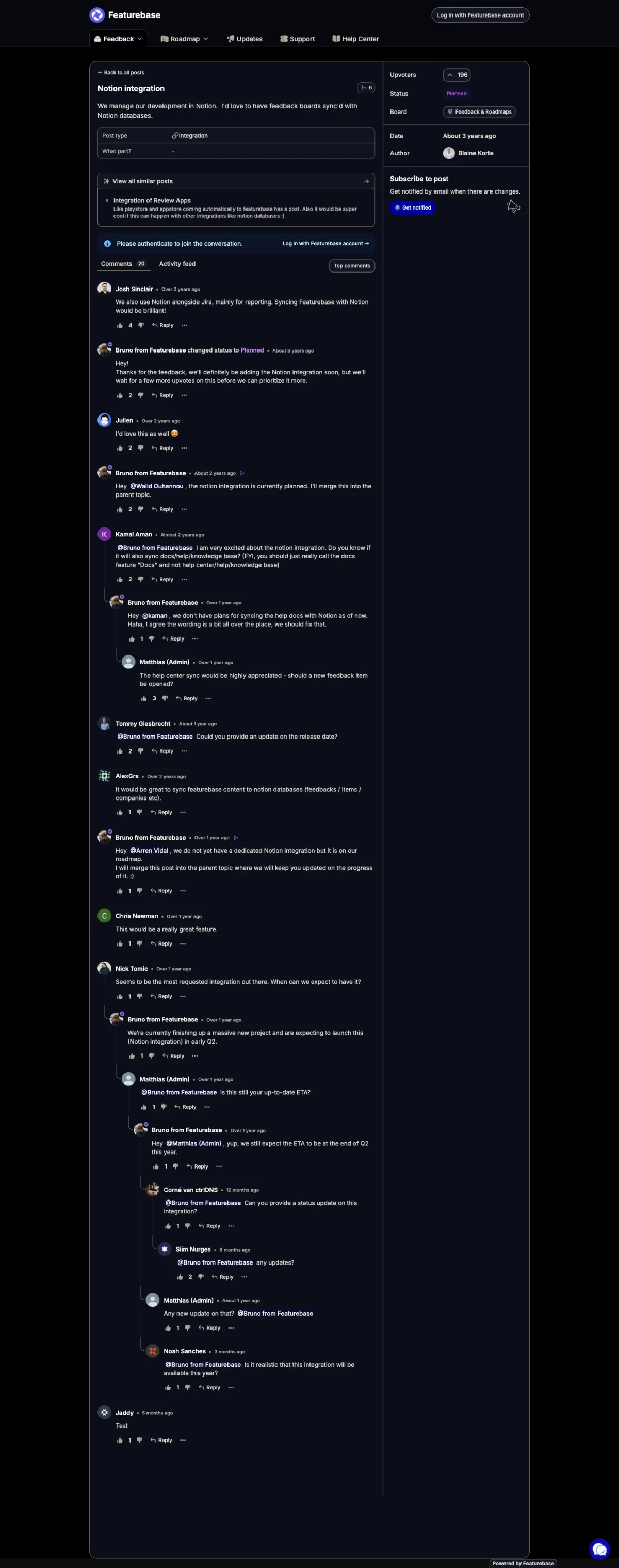
This thread would be easy to dunk on, and it does not deserve it. Every team that runs a public roadmap has a thread like this somewhere: a request that is popular, plausible, always about to be next quarter’s work, and always losing the prioritization fight to something on fire. The lesson we took is narrower. If you post an ETA on a public board, people will hold you to it, and going quiet costs more trust than never giving one.
The CEO who lives in Notion
Sleekplan’s version of the request is smaller, 18 votes, and it contains the cleanest statement of why this integration matters commercially:
“My CTO loves Sleekplan, and I (the company’s CEO) use Notion to monitor all our work. I would really love any time a feature is added, removed, updated from a ‘features’ table in notion it to update a relevant mirror on sleekplan.”
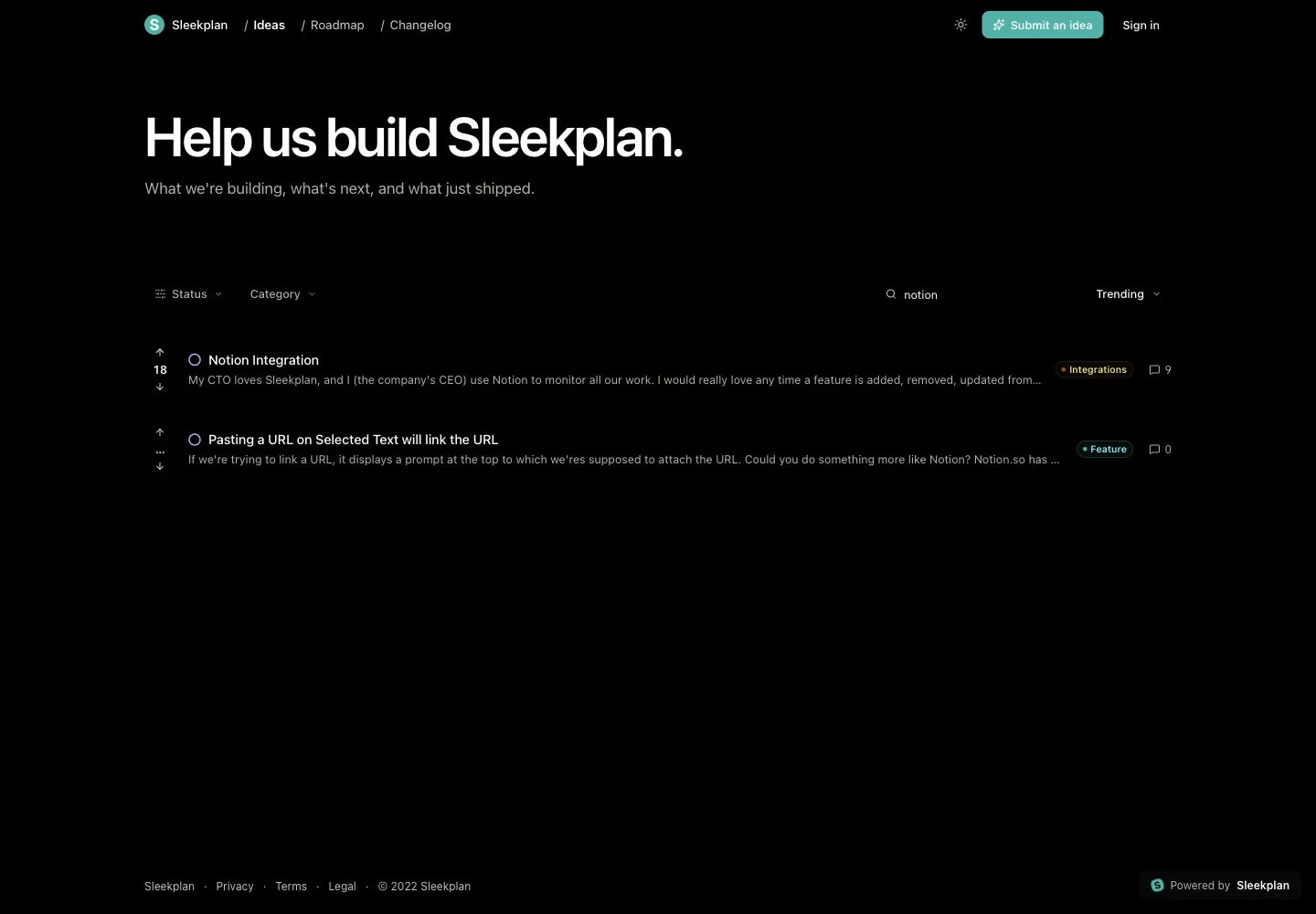
That quote is a sales call in miniature. The CTO already likes the tool. The CEO lives in Notion and wants the tool to meet him there. What he describes, Notion as the master copy and the feedback tool mirroring it, goes further than anything we built this night, but it is probably where this ends up.
Frill we can only report as an absence of evidence: no public catalog, no Notion mention on the marketing site or help index, and their board was unreachable without a login, so we make no claim about their private demand.
The requesters already wrote the spec
Put the threads side by side and the shape of the wanted feature is consistent. Database rows, not pages: Canny’s 2019 original asked for documents, and the 2023 to 2025 comments correct it, three of them saying “database” outright. Title, description, and status as the floor, with vote count, owner, and tags as the wish list. A database the customer chooses, in their own workspace. And ideally status flowing both ways. Six and a half years of comments amount to a product spec written by the people who want to buy it.
Part of why it stayed unbuilt is timing. Notion’s 2025-09-03 API version changed the object model, so databases became containers for data sources and a page create now targets a data source rather than the database itself. An integration written against the older API needs a real migration. The same release cuts the other way, though: internal integration tokens mean a customer can mint a secret inside their own workspace and paste it in, and the vendor never registers or maintains an OAuth app with Notion at all. The gap got cheaper to close at the same time it got more annoying for anyone with old code.
What we built in a night
So we built the version the threads describe. Setup is pasting a secret and picking a database. You create an internal integration in your Notion workspace, share your target database with it, and paste the secret into Usero, where it is stored encrypted. There is no OAuth app in between.
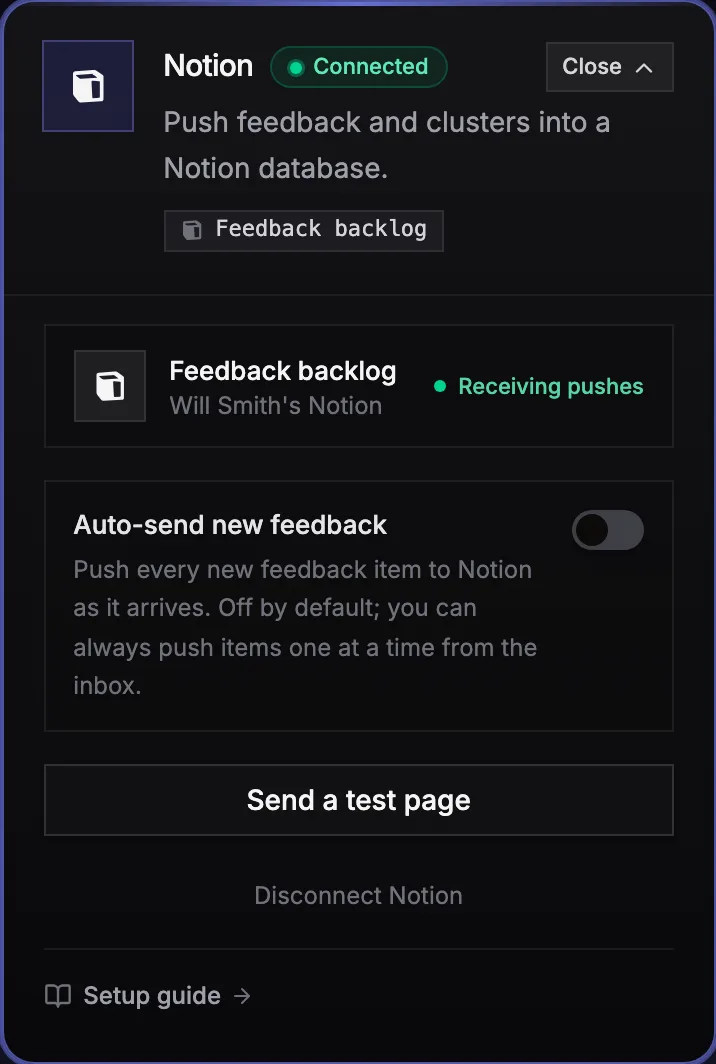
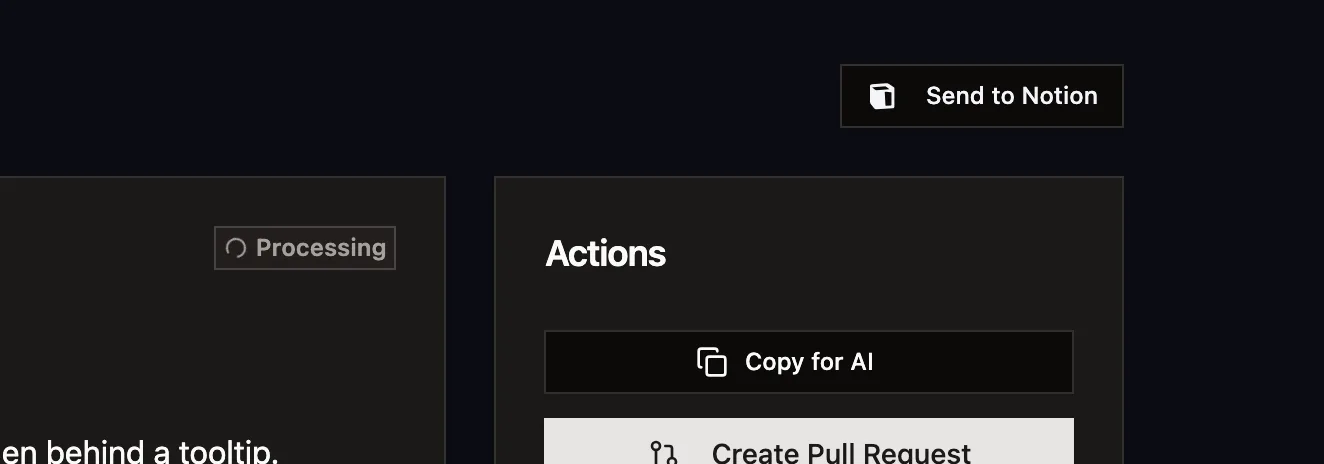
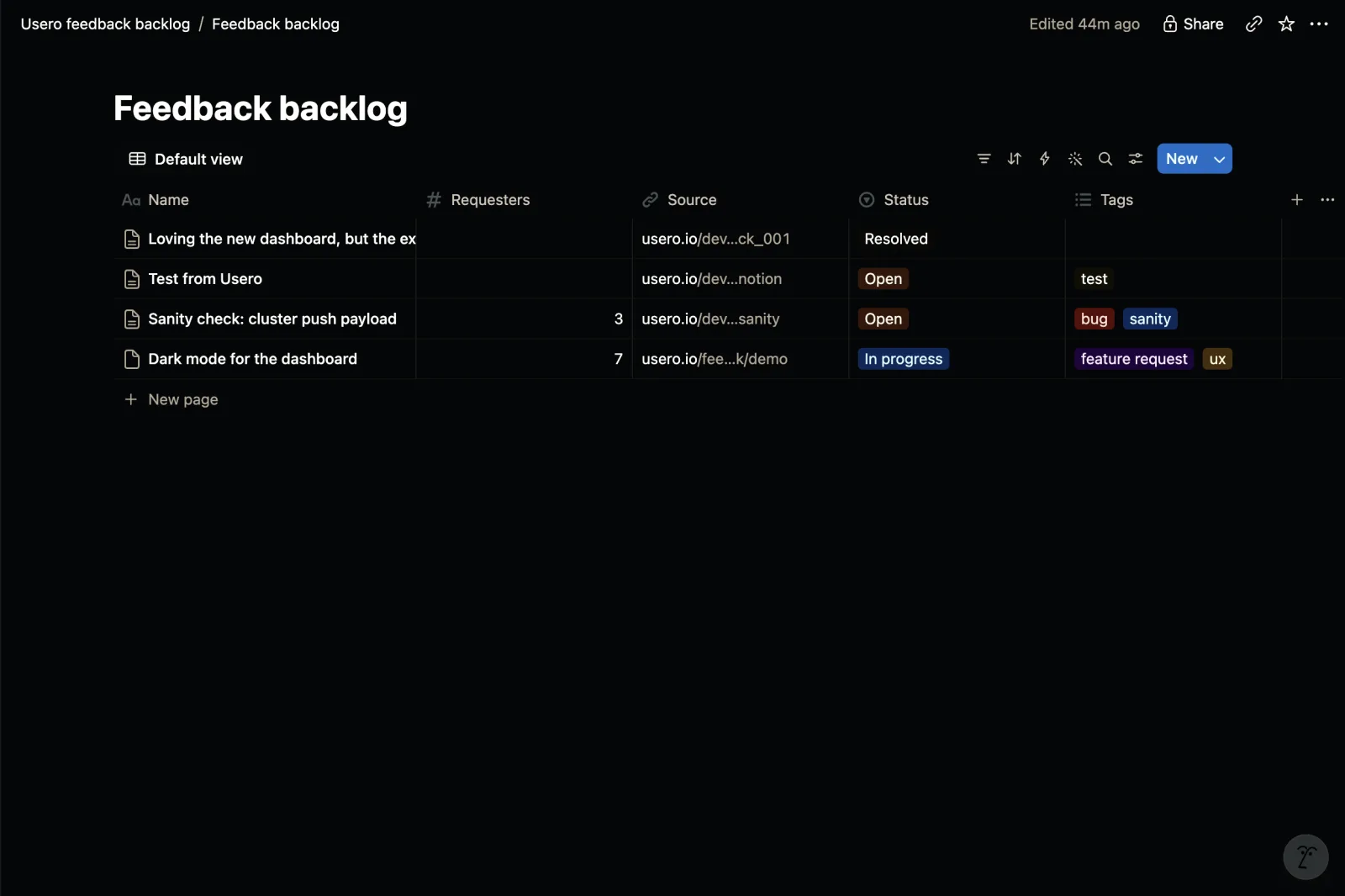
Sends are per item. Every feedback item and cluster gets a Send to Notion button, and each send creates a new row in the database you picked. The mapping is schema-aware: Usero reads your database’s properties and writes only the ones that exist, Status, Requesters, Source, and Tags where your schema has them, and always the title. A property your database lacks is skipped rather than failed on, so the push works on the database you already run instead of a template we make you adopt. The verbatim member quotes go in the page body, so the row answers “how many people asked, in their own words” without a trip back into Usero.
Auto-send exists as a toggle and ships off. Turn it on and new feedback is pushed as it arrives, while bulk imports are never auto-sent, so a CSV of 4,000 rows cannot flood your workspace. It is free on every plan. A push is two API calls, so we can afford that, and every competitor analogue we studied places tracker integrations inside a paid tier.
What ours does not do yet
Since half this post is about other teams’ public promises, here are ours, stated as limits rather than ETAs. The push is one-way. Sending an item that was already sent creates a new page instead of updating the old one, and the button relabels itself “Send again (new page)” so it never surprises you. Two-way status sync, the thing the Sleekplan CEO asked for, is the documented follow-up, and we notice that nobody in the category ships it natively for Notion today.
One more wrinkle: there is an open report of Notion’s firewall returning 403 to some API clients, and third-party endpoints behave differently from Cloudflare’s egress than from a laptop. We have been burned by exactly this before, so we treat the production network path as unproven until the integration passes a smoke test from the preview deploy, and the error handling surfaces a firewall block as a retryable message rather than a mystery failure.
The takeaway
The most requested integration in this category has been sitting in public view for six and a half years, spec attached, on the vendors’ own boards. It took one night to build against the current Notion API. We think the explanation is ordinary prioritization pressure rather than difficulty. The same pressure exists on our backlog, and our own oldest Planned item is due the same read.
And the reason it was worth our night: the cluster you push to Notion is one click from an AI-drafted pull request on the same screen. Notion gets the plan, GitHub gets the code, and both trace back to the same set of users asking for the same thing.
If you are comparing tools in this category, we also wrote up the Canny alternatives for indie hackers. Or try Usero free and push a cluster into your own Notion backlog.
Frequently Asked Questions
Does Canny have a Notion integration?
No. Canny lists 27 integrations on its public catalog and Notion is not one of them. The request for it is the top-voted item on Canny’s own Integrations board: 249 votes, opened 5 August 2019, still marked Under Review as of August 2026. The thread has one team reply in that time, from November 2023.
Does Featurebase have a Notion integration?
No. Featurebase lists 12 integrations and Notion is not among them. The request has 196 votes and has carried a Planned status for about three years. The team gave an ETA of early Q2, revised it to end of Q2 in the same thread, and the five status chases since then have gone unanswered.
Can I connect a feedback tool to Notion with Zapier?
That is what all four vendors suggest, and it works at the level of "a new post creates a page somewhere". What the requesters keep asking for is more specific: rows in a database they choose, with title, description, and status mapped to their own properties. A generic Zapier bridge makes you build and maintain that mapping yourself.
How does Usero’s Notion integration work?
You create an internal integration inside your own Notion workspace, paste its secret into Usero, and pick a database you have shared with it. There is no OAuth app in between. Pushing a feedback item or cluster creates a new row in that database, with properties filled where your schema has a match and the verbatim user quotes in the page body.
Is Usero’s Notion integration two-way?
No. It is a one-way push today. Sending the same item again creates a new page rather than updating the old one, and the button says so. Two-way status sync, where a change in Notion updates the item in Usero, is the documented follow-up. For what it is worth, none of the four competitors ship native two-way Notion sync either, because none of them ship Notion at all.
Is the Notion integration free in Usero?
Yes, on every plan. Auto-send is off by default, so nothing is pushed until you press the button or turn the toggle on, and bulk imports are never auto-sent.
Continue reading
How Featurebase Forwards Feedback to Issue Trackers: The Threshold That Never Fired
A hands-on teardown of Featurebase issue tracker forwarding: the upvote-threshold request their own team filed three years ago (200 upvoters, still Planned), the push-all toggle and manual flow behind the $29 per seat gate, the GitHub app that can only file issues, and the demand-threshold auto PR we built the same night.
9 min read
AI User Testing on Our Own Product: The Bugs It Found Were Not in the Code
We ran AI user testing against our own preview deploy: an agent driving a browser with a plain-English task. The first attempt found nothing useful and filed one confidently wrong finding. Three rounds of fixing the observation layer later it found a stale CI variable that 404s the Connect GitHub button and a sticky header eating a dialog close button, neither of which any static check can see. Costs, limits, and why this is closer to flow regression testing than usability research.
9 min read
AI User Testing: What It Catches, What It Misses, and What It Is Not
AI user testing means an agent driving a real browser through your product with a plain-English task, not a language model playing a persona. What it catches (structural friction between correct files), what it cannot see (anything visual), how it differs from usability research and from QA automation, and measured precision numbers from our own runs.
8 min read
Build a feedback loop your team actually uses
Usero collects, clusters, and turns user feedback into shipped fixes.
Get started free